Wednesday, 23 November 2011

Praying with Body, Mind & Voice


In the celebration of Mass we raise our hearts and minds to God. We are creatures of body as well as spirit, so our prayer is not confined to our minds and hearts. It is expressed by our bodies as well. When our bodies are engaged in our prayer, we pray with our whole person. Using our entire being in prayer helps us to pray with greater attentiveness. During Mass we assume different postures—standing, kneeling, sitting—and we are also invited to make a variety of gestures. These postures and gestures are not merely ceremonial. They have profound meaning and, when done with understanding, can enhance our participation in the Mass.

STANDING
Standing is a sign of respect and honor, so we stand as the celebrant who represents Christ enters and leaves the assembly. From the earliest days of the Church, this posture has been understood as the stance of those who have risen with Christ and seek the things that are above. When we stand for prayer, we assume our full stature before God, not in pride but in humble gratitude for the marvelous things God has done in creating and redeeming each one of us. By Baptism we have been given a share in the life of God, and the posture of standing is an acknowledgment of this wonderful gift. We stand for the proclamation of the Gospel, which recounts the words and deeds of the Lord. The bishops of the United States have chosen standing as the posture to be observed for the reception of Communion.

KNEELING
In the early Church, kneeling signified penance. So thoroughly was kneeling identified with penance that the early Christians were forbidden to kneel on Sundays and during the Easter season, when the prevailing spirit of the Liturgy was one of joy and thanksgiving. In the Middle Ages kneeling came to signify homage, and more recently this posture has come to signify adoration, especially before the presence of Christ in the Eucharist. It is for this reason that the bishops of this country have chosen the posture of kneeling for the entire Eucharistic Prayer

SITTING
Sitting is the posture of listening and meditation, so the congregation sits for the pre-Gospel readings and the homily and may also sit for the period of meditation following Communion. All should strive to assume a seated posture during the Mass that is attentive rather than merely at rest.

PROCESSIONS
Every procession in the Liturgy is a sign of the pilgrim Church, the body of those who believe in Christ, on their way to the Heavenly Jerusalem. The Mass begins with the procession of the priest and ministers to the altar. The Book of the Gospels is carried in procession to the ambo. The gifts of bread and wine are brought forward to the altar. Members of the assembly come forward in procession—eagerly, attentively, and devoutly—to receive Holy Communion. We who believe in Christ are moving in time toward that moment when we will leave this world and enter into the joy of the Lord in the eternal Kingdom he has prepared for us.

MAKING THE SIGN OF THE CROSS
We begin and end Mass by marking ourselves with the Sign of the Cross. Because it was by his death on the Cross that Christ redeemed humankind, we trace the Sign of the Cross on our foreheads, lips, and hearts at the beginning of the Gospel, praying that the Word of God may be always in our minds, on our lips, and in our hearts. The cross reminds us in a physical way of the Paschal Mystery we celebrate: the death and Resurrection of our Savior Jesus Christ.


BOWING
Bowing signifies reverence, respect, and gratitude. In the Creed we bow at the words that commemorate the Incarnation. We also bow as a sign of reverence before we receive Communion. The priest and other ministers bow to the altar, a symbol of Christ, when entering or leaving the sanctuary. As a sign of respect and reverence even in our speech, we bow our heads at the name of Jesus, at the mention of the Three Persons of the Trinity, at the name of the Blessed Virgin Mary, and at the name of the saint whose particular feast or memorial is being observed.

GENUFLECTING
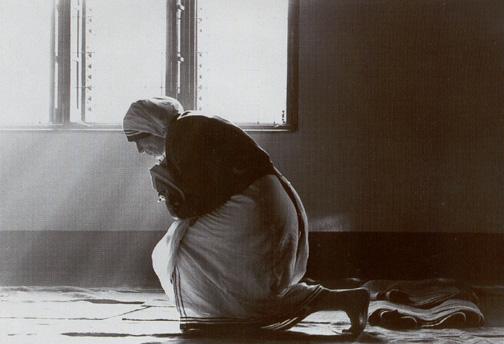
As a sign of adoration, we genuflect by bringing our right knee to the floor. Many people also make the Sign of the Cross as they bend their knee. Traditionally, Catholics genuflect on entering and leaving church if the Blessed Sacrament is present in the sanctuary of the Church. The priest and deacon genuflect to the tabernacle on entering and leaving the sanctuary. The priest also genuflects in adoration after he shows the Body and Blood of Christ to the people after the consecration and again before inviting the people to Holy Communion.

ORANS
The priest frequently uses this ancient prayer posture, extending his hands to his sides, slightly elevated. Orans means “praying.” Early Christian art frequently depicts the saints and others standing in this posture, offering their prayers and surrendering themselves, with hands uplifted to the Lord, in a gesture that echoes Christ’s outstretched arms as he offered himself on the Cross.

PROSTRATING
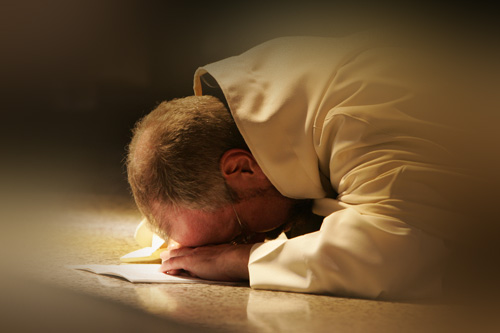
In this rarely used posture, an individual lies full-length on the floor, face to the ground. A posture of deep humility, it signifies our willingness to share in Christ’s death so as to share in his Resurrection (see Rom 6). It is used at the beginning of the Celebration of the Lord’s Passion on Good Friday and also during the Litany of the Saints in the Rite of Ordination, when those to be ordained deacons, priests, and bishops prostrate themselves in humble prayer and submission to Christ.


SINGING
“By its very nature song has both an individual and a communal dimension. Thus, it is no wonder that singing together in church expresses so well the sacramental presence of God to his people” (United States Conference of Catholic Bishops, Sing to the Lord, no. 2). As we raise our voices as one in the prayers, dialogues, and chants of the Mass, most especially in the Eucharistic Prayer, as well as the other hymns and songs, we each lend our individual voices to the great hymn of praise and thanksgiving to the Triune God.

PRAYING IN UNISON
In the Mass, the worshiping assembly prays in one voice, speaking or singing together the words of the prayers. By saying the same words at the same time, we act as what we truly are—one Body united in Christ through the Sacrament of Baptism.

BEING SILENT
“Silence in the Liturgy allows the community to reflect on what it has heard and experienced, and to open its heart to the mystery celebrated” (Sing to the Lord, no. 118). We gather in silence, taking time to separate ourselves from the concerns of the world and enter into the sacred action. We reflect on the readings in silence. We may take time for silent reflection and prayer after Holy Communion. These times of silence are not merely times when nothing happens; rather, they are opportunities for us to enter more deeply in what God is doing in the Mass, and, like Mary, to keep “all these things, reflecting on them” in our hearts (Lk 2:19).

CONCLUSION
The Church sees in these common postures and gestures both a symbol of the unity of those who have come together to worship and also a means of fostering that unity. We are not free to change these postures to suit our own individual piety, for the Church makes it clear that our unity of posture and gesture is an expression of our participation in the one Body formed by the baptized with Christ, our head. When we stand, kneel, sit, bow, and sign ourselves in common action, we give unambiguous witness that we are indeed the Body of Christ, united in body, mind, and voice.


REFERENCE
United States Conference of Catholic Bishops (USCCB). Sing to the Lord: Music in Divine Worship. Pastoral Liturgy Series 4. Washington, DC: USCCB, 2007.
Scripture texts used in this work are taken from the New American Bible, copyright © 1991, 1986, and 1970 by the Confraternity of Christian Doctrine, Washington, DC 20017

Tuesday, 8 November 2011

A Bibilical Walk Through the Mass,
Part 1

Excelent talks given by Dr. Edward Sri who is provost and professor of theology and Scripture at Augustine Institute in Denver Colorado. A nationally-known speaker and writer, Dr. Sri recently published "A Biblical Walk Thru The Mass: Understanding What We Say and Do in the Liturgy." And now he would like to take us through the Mass explaing every word and gesture  seeking its roots in the Bible, reviling unity of all the ages of Jewish and Christian worship.


When? Thursday, 10th of November at 6.30 PM.
Where?
Parish Hall, St. Joseph RC Church, St. Joseph.
 
You are most welcome!
  •  Envelopes for Masses for the Dead can be placed in the collection basket. Masses for the Dead will be celebrated until November 20th – Feast of Christ the King.
  • From this weekend we will begin distributing envelopes for the Archbishop’s Appeal Fund for the restoration of Our Mother Church– the Cathedral. This is a year-long exercise until October 2012, but the Feast of Christ the King is the main collection weekend. Collect an envelope or two, pray about it and give generously.
  •  Beginning this Sunday 6th November @ 6pm in the Parish Hall, we invite you to be part of “THE CINEMA CLUB”. Movies on the lives of the saints will be shown, to be followed with a brief discussion on the virtues of the saint, and ways we can apply them in our lives.

    The first feature film will bethe movie, MARIA GORETTI, a tragic, yet inspiring story of purity, compassion and forgiveness. Maria Goretti is the youngest saint of all times who died, defending her purity at the hands of a knife-wielding attacker.


    The Club is open to anyone and everyone and you don’t need an invite. Just come, bring someone and bring something to munch on and a lil’ something to drink (preferably, non-alcoholic)
  • As we are trying to prepare ourselves for the introduction of the new translation of the Roman Missal. we would like to invite you for projection of the recorded exellent – recommended by EWTN – talks by Dr. Edward Sri. In A Biblical Walk Through the Mass, Dr. Edward Sri takes us on a unique tour of the Liturgy. Based on the revised translation of the Mass which goes into effect Advent, 2011, his talks explore the biblical roots of the words and gestures we experience in the Liturgy which we know by heart but unfortunatelly do almost roboticlly.

    To go deeper into the code of the Mass, to learn how our celebrations are the continuation of the worship of Israel and all generations of Christians – these are our goals.

    This Thursday 10th of November at 6.30 pm in the Parish Hall.
  • Dancing with ‘D’ East Stars is the theme for our Annual Christmas Dinner on Sunday 11th December at Bishop’s Anstey East Auditorium, Trincity. Tickets are priced at $200.00 and are available from this weekend, from Fr. Karol, Morris Smith, Marjorie Valere, and Deacon Jeffrey – St. Joseph. Carol-Ann Villafana, Michael Hill and Merle Newton – Mt. D’or.

    Our dinner is one of the few events we come together as a parish family – Mt.D’or and St. Joseph. So we encourage you purchase a few tickets for you and family so that we can celebrate together.

Wednesday, 2 November 2011

Dominican School of Faith


Topics of the weekly meetings in Novemebr 2011

The Last Things

7th of Novemeber: Death.
14th of Novemeber: Judement.
21st of Novemeber: Hell, Purgatry, heaven.

On Mondays 7th, 14th and 21st of November, at 6.00 P.M. at the Thomas Aquinas Room, St. Dominic’s Pastoral Centre, Four Roads, Diego Martin.

For more information please contact: Fr. Karol Wielgosz O.P. at 773-7403 or karolek@dominikanie.pl or Karen at 680-6796.

MOVIE NIGHT: MARIA GORETTI

The story of Saint Maria Goretti is retold in this beautifully made new film from Italy. It tells of the plight of the poor laborers of the time, struggling to survive in a swampy area with rampant malaria and extreme poverty. Luigi and Assunta Goretti keep their faith despite the hardship, and instill in their children a deep love for God. Their daughter Maria especially is devout. Tragedy strikes more than once: sickness and death affects the Goretti family, and then their young neighbor Alessandro does the unthinkable. 

Date: Sunday November 7, 2011
Time: 6:00pm
Place: St Joseph’s Church
Running Time:  1 hour and 45 minutes
Language: Italian with English Subtitles
Food & Drinks: Bring your own drinks and snacks
Target Audience: 15+
Cost: FREE

Come early to ensure that you get a good seat!


31st Sunday of Ordinary Time, 30th of October 2011

  1.   There are still some envelopes available for Masses for the Dead. A reminder you can place this  envelope along with the envelopes for the flowers or Mass Intentions and Pledge in the collection basket. Or you can give it to Fathers or Deacon Jeffrey.
2.   The Mass for the Sick will take place Saturday 5th November @ 10AM here at St. Joseph. We encourage you to bring elderly members of your family. Also if you know of any elderly persons who are Catholic living in your neighbourhood, encourage them to come.
3.  Beginning Sunday 6th November @ 5pm in the Parish Hall, we invite to be part of “THE CINEMA CLUB”. We would be showing movies on the lives of the saints with a brief discussion after on the virtues of the saint, and ways we can apply them in our lives.
The first feature film will bethe movie, MARIA GORETTI, a tragic, yet inspiring story of purity, compassionand forgiveness. Maria Goretti is the youngest saint of all times who died, defending her purity at the hands of a knife-wielding attacker.
The Club is open to anyone and everyone. And you don’t need an invite. Just come, bring someone and bring something to munch on and a lil’ something to drink (non-alcoholic)
4.   Solemnity of All Saint Mass @ 6am on Tuesday 1st November. An ancient solemnity where we honour  the saints, known and unknown and our call to be saints.
5.  Wednesday 2nd November is the Mass for Commemoration of the Faithful Departed – ALL SOULS. There will be the usual morning Mass, Midday Mass and Mass in the Evening @ 5.30 pm with a procession to Our Catholic Cemetery – King Street & Queen Street
6.  As mentioned before, the Christmas Dinner is on Sunday 11th December at Bishop’s Anstey East Auditorium, Trincity. Tickets are available from this weekend, from Fr. Karol, Morris Smith, Marjorie Valere, Deacon Jeffrey.

Friday, 28 October 2011

ST. JUDE PRAY FOR US


ST JUDE PRAY FOR US!

Today we celebrate the feast of St. Jude who is one of the saint patrons of our parish. Jude (following article is taken from wikipedia) was one of the Twelve Apostles of Jesus. He is generally identified with Thaddeus, and is also variously called Jude of James, Jude Thaddaeus, Judas Thaddaeus or Lebbaeus. He is sometimes identified with Jude, "brother of Jesus", but is clearly distinguished from Judas Iscariot, another disciple, the betrayer of Jesus.

The Armenian Apostolic Church honors Thaddeus along with Saint Bartholomew as its patron saints. In the Roman Catholic Church he is the patron saint of desperate cases and lost causes.

Saint Jude's attribute is a club. He is also often shown in icons with a flame around his head. This represents his presence at Pentecost, when he received the Holy Spirit with the other apostles. Another common attribute is Jude holding an image of Jesus Christ, in the image of Edessa. In some instances he may be shown with a scroll or a book (the Epistle of Jude) or holding a carpenter's rule.

New Testament

Jude is clearly distinguished from Judas Iscariot, another disciple and later the betrayer of Jesus. Both "Jude" and "Judas" are translations of the name Ιούδας in the Greek original New Testament, which in turn is a Greek variant of Judah, a name which was common among Jews at the time. In most bibles in languages other than English and French, Jude and Judas are referred to by the same name.

"Jude of James" is only mentioned twice in the New Testament: in the lists of apostles in Luke 6:16 and Acts 1:13.

The name by which Luke calls the Apostle, "Jude of James" is ambiguous as to the relationship of Jude to this James. Though such a construction sometimes connotated a relationship of father and son, it has been traditionally interpreted as "Jude, brother of James" (Luke 6:16) though Protestants (for instance, the New International Version translation) usually identify him as "Jude son of James".

The Gospel of John also once mentions a disciple called "Judas not Iscariot" (John 14:22). This is often accepted to be the same person as the apostle Jude, though some scholars see the identification as uncertain.

In some Latin manuscripts of Matthew 10:3, he is called Judas the Zealot.

Possible Identity with Thaddeus

In the comparable apostle-lists of Matthew 10:3 and Mark 3:18, Jude is omitted, but there is a Thaddeus (or in some manuscripts of Matthew 10:3, "Lebbaeus who was surnamed Thaddaeus") listed in his place. This has led many Christians since early times to harmonize the lists by positing a "Jude Thaddeus", known by either name. This is made plausible by the fact that "Thaddeus" seems to be a nickname (see Thaddeus).

A further complication is the fact that the name "Judas" was tarnished by Judas Iscariot. It has been argued that for this reason it is unsurprising that Mark and Matthew refer to him by an alternate name.

Some Biblical scholars reject this theory, however, holding that Jude and Thaddeus did not represent the same person. Scholars have proposed alternate theories to explain the discrepancy: an unrecorded replacement of one for the other during the ministry of Jesus because of apostasy or death; the possibility that "twelve" was a symbolic number and an estimation; or simply that the names were not recorded perfectly by the early church.

Thaddeus the apostle is generally seen as a different person from Thaddeus of Edessa, one of the Seventy Disciples.

Brother of Jesus?

Opinion is divided on whether Jude the apostle is the same as Jude, brother of Jesus, who is mentioned in Mark 6:3 and Matthew 13:55-57, and is the traditional author of the Epistle of Jude.

Some Catholics believe the two Judes are the same person, while Protestants do not.

Tradition and legend

Tradition holds that Saint Jude preached the Gospel in Judea, Samaria, Idumaea, Syria, Mesopotamia and Libya. He is also said to have visited Beirut and Edessa, though the emissary of latter mission is also identified as Thaddeus of Edessa, one of the Seventy. The 14th-century writer Nicephorus Callistus makes Jude the bridegroom at the wedding at Cana.

The legend reports that St. Jude was born into a Jewish family in Paneas, a town in Galilee later rebuilt by the Romans and renamed Caesarea Philippi. In all probability he spoke both Greek and Aramaic, like almost all of his contemporaries in that area, and was a farmer by trade. According to the legend, St. Jude was a son of Clopas and his wife Mary, a sister of the Virgin Mary. Tradition has it that Jude's father, Clopas, was murdered because of his forthright and outspoken devotion to the risen Christ. After Mary's death, miracles were attributed to her intercession.

Although Saint Gregory the Illuminator is credited as the "Apostle to the Armenians", when he baptized King Tiridates III of Armenia in 301, converting the Armenians, the Apostles Jude and Bartholomew are traditionally believed to have been the first to bring Christianity to Armenia, and are therefore venerated as the patron saints of the Armenian Apostolic Church. Linked to this tradition is the Saint Thaddeus Monastery (now in northern Iran) and Saint Bartholomew Monastery (now in southeastern Turkey) which were both constructed in what was then Armenia.

Death and remains

According to the Armenian tradition, Saint Jude suffered martyrdom about 65 AD in Beirut, in the Roman province of Syria, together with the apostle Simon the Zealot, with whom he is usually connected. Their acts and martyrdom were recorded in an Acts of Simon and Jude that was among the collection of passions and legends traditionally associated with the legendary Abdias, bishop of Babylon, and said to have been translated into Latin by his disciple Tropaeus Africanus, according to the Golden Legend account of the saints.

Sometime after his death, Saint Jude's body was brought from Beirut to Rome and placed in a crypt in St. Peter's Basilica which is visited by many devotees. According to popular tradition, the remains of St. Jude were preserved in an Armenian monastery on an island in the northern part of Issyk-Kul Lake in Kyrgyzstan at least until the mid-15th century. Later legends either deny that the remains are preserved there or claim that they were moved to a yet more desolate stronghold in the Pamir Mountains. Recent discovery of the ruins of what could be that monastery may put an end to the dispute.

Iconography

Jude is traditionally depicted carrying the image of Jesus in his hand or close to his chest, betokening the legend of the Image of Edessa, recorded in apocryphal correspondence between Jesus and Abgar which is reproduced in Eusebius' History Ecclesiastica, I, xiii. Eusebius relates that King Abgar of Edessa (now Şanlıurfa in southeast Turkey) sent a letter to Jesus seeking a cure for an illness afflicting him. With the letter he sent his envoy Hannan, the keeper of the archives, offering his own home city to Jesus as a safe dwelling place. The envoy painted a likeness of Jesus with choice paints (or alternatively, impressed with Abgar's faith, Jesus pressed his face into a cloth and gave it to Hannan) to take to Abgar with his answer. Upon seeing Jesus' image, the king placed it with great honor in one of his palatial houses. After Christ's execution, Thomas the Apostle sent Jude to King Abgar and the king was cured. Astonished, he converted to Christianity, along with many of the people under his rule. Additionally, St. Jude is often depicted with a flame above his head, representing his presence at Pentecost, when he was said to have received the Holy Spirit with the other apostles.

Veneration

The Order of Preachers (the Dominicans) began working in present day Armenia soon after their founding in 1216. There was a substantial devotion to St. Jude in this area at that time, by both Roman Catholic and Orthodox Christians. This lasted until persecution drove Christians from the area in the 18th century. Devotion to Saint Jude began again in earnest in the 19th century, starting in Italy and Spain, spreading to South America, and finally to the United States (starting in the area around Chicago) owing to the influence of the Claretians and the Dominicans in the 1920s.